
Learning Plan
Introduction
1. Introduction
1.1 INTRODUCTION AND OVERVIEW
A4 is a full-service real estate and immigration agency in Portugal, offering expert support in property transactions, relocation, property management and financial navigation. We believe that people are the key asset of our company, which is why we invest in the growth of our agents. Through structured training, educational resources, and career development opportunities, we empower professionals to excel in the real estate industry.
Our multilingual team, innovative approach, and commitment to excellence ensure a seamless experience for both clients and agents, making A4 a trusted partner in the market.
Our multilingual team, innovative approach, and commitment to excellence ensure a seamless experience for both clients and agents, making A4 a trusted partner in the market.

1.2 Internal Terms Used
**Processing** — the process of managing a client.
In internal communication, managers may use the following generalized program terms:
In internal communication, managers may use the following generalized program terms:
- Funds — application under the Golden Visa program
- Passive Income — application under the D7 program
- Company Formation — application under the D2 visa
- Digital Nomad does not have a different internal corporate name
- Immigration Expert (IE) — a sales department employee at A4 Real Estate — hereinafter referred to as Immigration Expert (IE).
- Client — an individual interested in acquiring services from the Company in one or more of its areas of activity.
- Target Lead — a unique "live" contact with accurate data and a direct interest in a product or service.
- Non-Target Lead — a unique contact with either no direct interest in the product or an interest in products or services not offered by us.
- Unique Client — a Client who has not previously contacted A4 Real Estate (not registered in Bitrix).
1.3 Established Terms in Real Estate and Immigration
RBI — Residency By Investment
CBI — Citizenship by Investment
CBI — Citizenship by Investment
Immigration
Immigration Services
At A4, we ensure every immigration process is completed successfully, guiding clients from start to finish. We work exclusively with trusted lawyers and partners, carefully selecting the best legal pathways based on each client’s unique situation. Our team provides full support, ensuring a seamless relocation experience. With a client-focused approach, we help navigate visa and residency programs efficiently, making the transition to Portugal as smooth and secure as possible.
We work exclusively with government-approved programs, ensuring compliance and security. Our team of immigration specialists assists investors, business owners, skilled professionals, students, and families in finding the best pathway for relocation.
At A4, we ensure every immigration process is completed successfully, guiding clients from start to finish. We work exclusively with trusted lawyers and partners, carefully selecting the best legal pathways based on each client’s unique situation. Our team provides full support, ensuring a seamless relocation experience. With a client-focused approach, we help navigate visa and residency programs efficiently, making the transition to Portugal as smooth and secure as possible.
We work exclusively with government-approved programs, ensuring compliance and security. Our team of immigration specialists assists investors, business owners, skilled professionals, students, and families in finding the best pathway for relocation.
Lesson 1 — What Immigration Products Do We Offer?
We specialize in immigration to Portugal (Spain soon to be added to our services). Although there are many opportunities for legal residency in both countries, we have identified the key programs that are in demand and that we are interested in offering.
We handle all types of visas but offer only reliable and suitable options tailored to each client's needs.
We handle all types of visas but offer only reliable and suitable options tailored to each client's needs.
What You Will Learn:
Here are the visas that we offer:
- The types of visas we offer.
- The main differences between them.
Here are the visas that we offer:
On June 3, 2024, the Portuguese government made changes to the Foreigners' Act. Articles 81.6, 81.7, 88.2, 88.6, 89.2 (IP), 89.4 (startup visa), and 89.5 have been repealed.
The repeal of the Manifestaçao de Interesse (Expression of Interest) scheme has been implemented. This popular scheme allowed individuals to enter the country on a tourist Schengen visa and apply for residency while already in Portugal, with the possibility of obtaining citizenship after 5 years. All applications submitted under this scheme before June 3, 2024, will still be considered.
The repeal of the Manifestaçao de Interesse (Expression of Interest) scheme has been implemented. This popular scheme allowed individuals to enter the country on a tourist Schengen visa and apply for residency while already in Portugal, with the possibility of obtaining citizenship after 5 years. All applications submitted under this scheme before June 3, 2024, will still be considered.
What does it mean to offer an immigration program to a client? It involves conducting an initial consultation, understanding and analyzing the client's case, determining the appropriate type of residency permit, and sending the corresponding offer — a file with a detailed description of the program.
To understand the client: The difference between applying for a visa independently and using agency services goes beyond just filling out forms and meeting deadlines. Our company’s lawyers carefully study the conditions for each visa, analyze them, and offer tailored solutions on how to combine tools to help the client maximize their benefits.
Our focus is on investment programs.
Remember
What’s next?
We have covered the product aspect (WHAT we sell). Next, we will look in detail at processing (HOW we sell).
Remember
- In general, any D visa implies residency in the country, except for the "Golden Visa." Portugal: When renewing the residency permit, the basis (visa types) can be changed. It is important that this transition happens at least 1 year before the current type of residency permit expires. It is theoretically possible, but it is necessary to compare the timelines of the programs to avoid resetting the count (for example, if you decide to apply for the "Golden Visa," which has a 2-year processing time, and the current visa expires in 1 year, there is a risk of interrupting the day count for subsequent permanent residency).
- In Portugal, all types of residency permits are issued for 2 years and then renewed for 3 (except for the student visa, which is issued for 1 year and is not part of our course, and the Golden Visa, where the renewal scheme is 2+2+2 years). In Spain, permits are issued for 3 years and then renewed for 2 years. In both countries, 5 years are required for permanent residency, but unlike Portugal, where citizenship can be applied for after 5 years, in Spain, you need to wait an additional 5 years and obtain citizenship only after a total of 10 years.
- Theoretically, we can work with other types of visas, but the programs covered in the training have stood the test of time and benefit.
- 1 contract = 1 service. If we have a contract for the "Golden Visa" and the client wants to start a business under this visa, starting a business is considered a separate service.
- Some visas can be applied for from both inside and outside Portugal, while others can only be applied for from outside Portugal. For example, HQA (Highly Qualified Professional), D7 (Financially Independent), Digital Nomad, and Golden Visa can be applied for both in Portugal and from another country.
- For all D visas, the client must be present in Portugal for 183 days. This way, they become a resident and pay taxes in Portugal.
What’s next?
We have covered the product aspect (WHAT we sell). Next, we will look in detail at processing (HOW we sell).
Study materials:
External links on the topic:
Legal framework for obtaining residency and citizenship in Portugal:
Homework:
Answers to the questions:
External links on the topic:
- Changes to the Foreigners Law as of June 3, 2024 (repeal of Articles 81.6, 81.7, 88.2, 88.6, 89.2 (IP), 89.4 (startup visa), 89.5.)
- Changes to the Citizenship Law as of March 5, 2024 (amendment regarding the start date for citizenship calculation from the moment the case is approved by AIMA)
- https://aima.gov.pt/pt
- Official Gazette of Portugal Diário da República
Legal framework for obtaining residency and citizenship in Portugal:
- Law on Foreigners No. 23/2007 of July 4, 2007 (as amended on June 2, 2023)
- Regulatory Decree No. 1/2024 of January 17, 2024 (clarification of the provisions and application of the regulations for the application of the law on foreigners)
- Citizenship Law No. 37/81 of October 3, 1981 (last amended November 10, 2020)
- Regulation on Portuguese citizenship No. 237-A/2006 of December 14, 2006 (with the latest amendments and additions of March 18, 2022 and June 2, 2023)
Homework:
- For self-study: Review the information that potential clients see when they first come into contact with the company.
Answers to the questions:
- A potential client reviewed the offer and asks why the package of documents is mentioned multiple times in the offer.
The correct answer is: In Portugal, all documents are valid for 6 months. If documents, including birth and marriage certificates, are older than this, their apostille and notarization need to be updated.
Click on the icon to see the correct answer
Lesson 2 — How We Work (Processing)
What will you learn?
From the introductory lesson, you understood that in the commonly accepted terminology of the real estate and immigration markets, the process of working with clients is referred to as processing. We will now explore how the entire process unfolds from the moment the client selects a program, pays the invoice, and signs the Service Agreement.
From the introductory lesson, you understood that in the commonly accepted terminology of the real estate and immigration markets, the process of working with clients is referred to as processing. We will now explore how the entire process unfolds from the moment the client selects a program, pays the invoice, and signs the Service Agreement.
Consular appointments must be made in advance, and the waiting period is 6 months!
What does the client need to do first to have a chance of success in Portugal?
Examples of steps can be found in the prepared offers for each type of visa, but here is a general outline:
The responsible executor can be a company or an individual with the required skills and necessary permits to manage immigration processes.
Note:
For the bank account:
Examples of steps can be found in the prepared offers for each type of visa, but here is a general outline:
The responsible executor can be a company or an individual with the required skills and necessary permits to manage immigration processes.
- Gather all necessary documents and preliminarily coordinate with the responsible executor, representing A4.
- Prepare the contract and invoice (the client signs the contract and pays 50% of the invoice).
- Schedule an appointment with the Consulate in the country of citizenship.
- Obtain a Portuguese tax number (NIF). The NIF can be obtained remotely within 5 days by granting a power of attorney to the responsible executor. The tax number includes address details, which can be either a Portuguese address or a foreign address.
- Open a bank account. To open a bank account, you also need to provide an address. For the bank, only a Portuguese address is acceptable (based on a rental agreement).
Note:
For the bank account:
- Work documents
- Portuguese address
What’s next?
Once the NIF is obtained and the bank account is opened, the next steps depend on the specific program the client is applying for.
Once the NIF is obtained and the bank account is opened, the next steps depend on the specific program the client is applying for.
Lesson 3 — "Golden Visa"
"Golden Visa" — A Residency and Citizenship Opportunity in Portugal for Investors Who Wish to Stay Less Than Six Months a Year
What you will learn:
Key Advantages of the Golden Visa:
Investment Options for the "Golden Visa" Include:
For all these scenarios, the investment must be maintained until the visa/permanent residency/citizenship is obtained (depending on the selected service package).
Intermediate Tasks:
Remember:
What you will learn:
- How to quickly and succinctly answer the question of the advantages of the "Golden Visa."
- Possible investment options.
Key Advantages of the Golden Visa:
- No requirement for permanent residence in the country (only 7 days in Portugal). For all other visa types (except the Golden Visa), you need to live in the country for 183 days and be a tax resident to extend residency and obtain citizenship.
Investment Options for the "Golden Visa" Include:
- €500,000 minimum investment in specific non-real estate funds (most optimal option).
- Non-refundable investment of at least €500,000 in science.
- Contribution of €250,000 or more in art or cultural heritage preservation.
- Company creation with at least €500,000 capital and a minimum of 5 new jobs or with any capital and at least 10 new jobs.
For all these scenarios, the investment must be maintained until the visa/permanent residency/citizenship is obtained (depending on the selected service package).
Intermediate Tasks:
- A client has approached you with a request for a Golden Visa. What 10 questions would you ask to understand which scenario — capital investments, job creation, investment in research and development, or support for cultural and artistic projects — to follow?
Remember:
- Funds can be sold after 5 years, but it’s better to wait until citizenship is obtained and then sell your shares (i.e., after 6-7 years). Exiting the fund earlier forfeits the option of obtaining citizenship.
- Investment in cultural heritage can be less than €250,000 if it is in regional areas (discount up to 30%).
Investment in funds is the most profitable option for the agent, allowing them to earn more!
What’s next?
Overview of the Digital Nomad Visa and why it has nothing to do with IT specialists.
Overview of the Digital Nomad Visa and why it has nothing to do with IT specialists.
Download study materials:
Links to official and recommended resources:
Links to official and recommended resources:
Lesson 4 — Digital Nomad Visa in Portugal
Also known as the Digital Nomad Visa, it is considered a related program to the D7 visa.
What you will learn:
Digital Nomad does not equal IT!
This program is available to any applicants who have an employment contract allowing remote work.
Key Points:
What you will learn:
Digital Nomad does not equal IT!
This program is available to any applicants who have an employment contract allowing remote work.
Key Points:
- Active income requirement starting January 2025 — €3,480 per applicant (proof required: income certificate for the last 3-6 months);
- Opening a bank account in Portugal is not mandatory;
- A rental agreement for housing in Portugal is required.
Remember:
Key points for successfully obtaining the Digital Nomad Visa.
What’s next:
In the next lesson, we will review the D7 Visa for financially independent individuals.
Feedback:
Please rate the usefulness of the information or suggest ideas for improving the lesson.
Key points for successfully obtaining the Digital Nomad Visa.
What’s next:
In the next lesson, we will review the D7 Visa for financially independent individuals.
Feedback:
Please rate the usefulness of the information or suggest ideas for improving the lesson.
Download study materials:
Lesson 5 — D7 Visa for Financially Independent Individuals
D7 Visa — also known as the Passive Income Visa — is for individuals with a regular income who wish to move to Portugal.
What you will learn:
Income must be declared and presented for the last 12 months! Once it is determined that the client might qualify for the D7 Visa, immediately check if they have a tax return for the previous year.
Passive Income Examples:
What you will learn:
- After reviewing the main offer for the visa, we will delve into the details in the lesson.
Income must be declared and presented for the last 12 months! Once it is determined that the client might qualify for the D7 Visa, immediately check if they have a tax return for the previous year.
Passive Income Examples:
- Renting out an apartment
- Dividends
Remember:
What’s next:
Introduction to the D2 Visa for entrepreneurs.
- Income for the past 12 months must be declared and taxes paid. Only then can the case potentially qualify for the D7 Visa.
- The required passive income amount for one applicant is €1,000 (Portugal's minimum wage of €870 + taxes). For other adult family members, add 50%, and for minor children, add 30%.
- Even if the income is passive and comes from abroad, a Portuguese bank account must be opened (see Lesson 2: How We Work). The account should have between €10,000 and €100,000 until the residency card is issued.
- Once legalized in Portugal with the D7 Visa, you can open a company (i.e., turn passive income into active income).
What’s next:
Introduction to the D2 Visa for entrepreneurs.
Download study materials:
Lesson 6 — D2 Visa for Entrepreneurs in Portugal
Also known as: Visa for entrepreneurs, active income, starting a business, business relocation.
Five Key Points:
Interactive Task: Determine the incorrect statement about the D2 Visa
Instructions: Read the following statements and select the one that is incorrect.
Five Key Points:
- It is necessary to open a personal bank account.
- It is necessary to register a company or set up as a sole proprietor.
- The client should have a minimum balance of €10,440 in a Portuguese bank account and demonstrate sufficient income (from €870 per month for sole proprietors; there is no minimum investment requirement for starting a business).
- The client must secure a long-term rental contract in Portugal for at least one year.
Interactive Task: Determine the incorrect statement about the D2 Visa
Instructions: Read the following statements and select the one that is incorrect.
- The D2 Visa requires the entrepreneur to invest a significant amount into the Portuguese economy.
- To obtain a D2 Visa, it is necessary to provide a detailed business plan.
- The D2 Visa is granted exclusively to those planning to engage in agriculture.
- D2 Visa holders have the right to reside in Portugal for two years with the possibility of extension.
Remember:
What’s next:
- The D2 Visa is designed for foreign entrepreneurs planning to start or develop a business in Portugal.
- The necessity of providing a detailed and realistic business plan.
- Proof of sufficient financial resources to support the business and living expenses in Portugal.
- The ability to live, work, and study in Portugal, as well as travel within the Schengen Area.
- The visa is issued for two years with the possibility of extension.
- All business setup services are paid for separately by the client.
What’s next:
- A comparison test of all the studied programs.
Statement 3 is incorrect. The D2 Visa is not limited to agricultural activities but is available for any type of entrepreneurial activity.
Click on the icon to see the correct answer
Download study materials:
Links to official and recommended resources:
Links to official and recommended resources:
- The procedure for obtaining residency for entrepreneurs is established by Article 89 of Law No. 23/2007 of July 4, which sets the legal regime for the entry, stay, exit, and deportation of foreigners from Portugal.
Real estate
Introduction
The Real Estate Sales Department has prepared a detailed manual on real estate operations. By completing this section of the A4 Mindspace, you will learn how to navigate the manual and associated documents, as well as discover additional tips shared by colleagues during in-person training sessions.
A4 Real Estate has significant experience working with foreign investors and conducting remote transactions. However, clients can also be local from the domestic market.
We highly recommend carefully reviewing the file Market Overview and Agent Workflow. It provides advice on how to develop an agent's real estate insight, which social media groups to join, and which websites to check for interesting neighborhood ratings.
The list of downloadable materials includes all the essential files for study, but they will also be repeated in the lessons related to the respective topics — for reinforcement and to build understanding.
! Our main folder, which contains all the necessary real estate documents, is 📁 Real Estate. All mentioned files and even direct links to them can ultimately be found in this root folder.
A4 Real Estate has significant experience working with foreign investors and conducting remote transactions. However, clients can also be local from the domestic market.
We highly recommend carefully reviewing the file Market Overview and Agent Workflow. It provides advice on how to develop an agent's real estate insight, which social media groups to join, and which websites to check for interesting neighborhood ratings.
The list of downloadable materials includes all the essential files for study, but they will also be repeated in the lessons related to the respective topics — for reinforcement and to build understanding.
! Our main folder, which contains all the necessary real estate documents, is 📁 Real Estate. All mentioned files and even direct links to them can ultimately be found in this root folder.
What’s next:
We will review the specific types of real estate properties we sell.
We will review the specific types of real estate properties we sell.
Download study materials:
Links to official and recommended resources:
- Global Property Guide —Авторитетный источник информации о покупке зарубежной недвижимости. Лидер рынка данных по европейской недвижимости.
- Официальный сайт Европейской ассоциации профессионалов рынка недвижимости
Lesson 1 — What We Sell
What you will learn:
- The neighborhoods where we sell real estate.
- A step-by-step script for client management.
- How actions and preparatory work can build your reputation as an experienced specialist capable of addressing clients' investment needs.
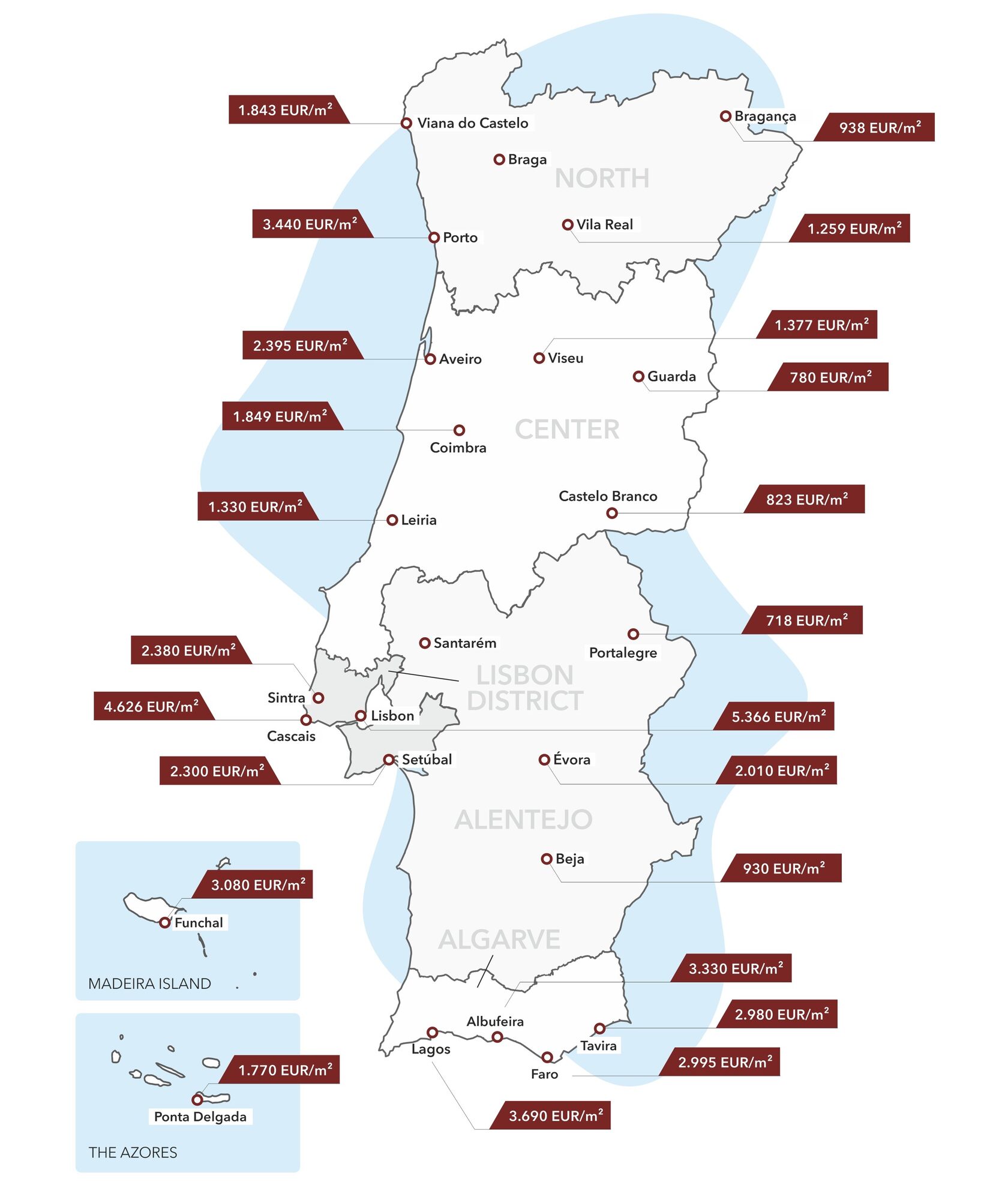
Regions where we work with new developments:
- New Developments
- Secondary Market Properties
- Commercial Properties

- Land
- Industrial Warehouses

!No transaction begins without the client having:
- NIF (Portuguese Tax Identification Number)
- A bank account in Portugal (In exceptional cases with New Developments, an escrow account with a lawyer may be used as an alternative).
We prioritize New Developments but also work with the secondary market. Our goal is to find the ideal property for each client while ensuring commissions for both the company and the manager.
The database of new developments is in the Google Sheets File. The file is divided into several tabs — one for each region where we sell properties (see above).
Please review the table and all available columns carefully.
The database of new developments is in the Google Sheets File. The file is divided into several tabs — one for each region where we sell properties (see above).
Please review the table and all available columns carefully.
!In the table, there is could be a column labeled "Fake Name" (not the actual name). Be sure to use the name from this column when communicating with clients.
!The table contains links to property listings on developers' websites, which often include additional information such as attractive videos and more comprehensive brochures. To present yourself as an expert and provide the client with the most thorough understanding of the property, utilize these materials when preparing and forming your proposal.
!The table contains links to property listings on developers' websites, which often include additional information such as attractive videos and more comprehensive brochures. To present yourself as an expert and provide the client with the most thorough understanding of the property, utilize these materials when preparing and forming your proposal.
Lesson 2 — How We Sell (Processing)?
In the body of the lesson, we will not delve into the processes in detail, as they are thoroughly outlined in the files below
(links to the files — in the Study Materials).
These documents are guides to real estate sales procedures provided by A4 Real Estate. The documents describe the steps consultants follow when selling or renting property, including the procedures for making offers, reserving properties, and preparing for the signing of a preliminary purchase agreement (CPCV). They also outlines the rules for resolving conflicts of interest, consultants' responsibilities during the sale process, and details related to preparing the CPCV and cooperating with other real estate agencies. The focus is on ensuring transparency and accuracy throughout all stages of the transaction.
The processing will differ for new developments and the secondary market. In the links to the study files, you will find detailed instructions on the stages of acquiring property for both types of markets.
(links to the files — in the Study Materials).
These documents are guides to real estate sales procedures provided by A4 Real Estate. The documents describe the steps consultants follow when selling or renting property, including the procedures for making offers, reserving properties, and preparing for the signing of a preliminary purchase agreement (CPCV). They also outlines the rules for resolving conflicts of interest, consultants' responsibilities during the sale process, and details related to preparing the CPCV and cooperating with other real estate agencies. The focus is on ensuring transparency and accuracy throughout all stages of the transaction.
The processing will differ for new developments and the secondary market. In the links to the study files, you will find detailed instructions on the stages of acquiring property for both types of markets.
Remember:
- The start of any dialogue with a potential lead involves understanding whether they have an NIF and a bank account in Portugal. If they do not have a Portuguese bank account, ascertain where their funds are located (countries, banks, budgets). This affects the range of purchasing possibilities in Portugal.
- Qualify the lead — assess the seriousness of their intentions and their potential transaction amounts (refer to the Marketing and Sales section for details).
- Register the client. This is necessary not only to gather their information but also to prevent situations where a client might try to proceed directly with the developer after receiving preliminary information from you.
- Client's funds must be verified. However, there are many ways to handle this legally through payment guarantors if there are difficulties in proving the source of the funds.
20% of properties priced at €200,000 in Portugal sell within a week!
Only 10% of property owners in Portugal sell their properties independently; most prefer to work with agents.
What’s Next?
We will look at the operational side of the process — handling documents and interacting with the legal department.
We will look at the operational side of the process — handling documents and interacting with the legal department.
Download study materials:
- Market Overview and Agent Workflow
- Primary Market Property Sales Procedure
- Secondary Market Property Sales Procedure
- SALES MANAGER PROCEDURE FOR HANDLING CLIENT INQUIRIES ABOUT REAL ESTATE IN PORTUGAL
- Client Qualification Questions: Buying Process
- Client Qualification Questions: Rental Process
- CLIENT REGISTRATION REQUIREMENTS WITH PORTA DA FRENTE, JLL & CASTELHANA
Lesson 3 — Mortgage
Mortgage Approval: Primary vs. Secondary Market
Securing a mortgage for secondary market properties is generally easier than for new developments. On the primary market, banks only process mortgage applications once construction is complete, meaning buyers must first make reservation and CPCV payments. If the mortgage is denied, it’s crucial to ensure that the developer will either refund the deposit, repurchase the property, or allow assignment to another buyer.
This must be negotiated and included in the contract with the developer.
Securing a mortgage for secondary market properties is generally easier than for new developments. On the primary market, banks only process mortgage applications once construction is complete, meaning buyers must first make reservation and CPCV payments. If the mortgage is denied, it’s crucial to ensure that the developer will either refund the deposit, repurchase the property, or allow assignment to another buyer.
This must be negotiated and included in the contract with the developer.
Remember:
- The minimum down payment is 20%, and for non-residents, it's 30%. You must initially have 50% of your own funds (30-40% for the mortgage and 10% for taxes and notaries).
- Mortgage rates on the secondary market can be up to 7%.
- Commercial properties cannot be financed with a mortgage.
- By the time of signing the Escritura contract, all taxes from the buyer’s side must already be paid.
What’s next?
You will take a test on the real estate training material.
You will take a test on the real estate training material.
Mortgage Application: Essential Questions
If a client decides to apply for a mortgage, the following questions must be answered before submitting the application to the appropriate specialists. These questions are listed in the Client Qualification Questions: Buying Process file.
5. Citizenship.
6. Do you have a Portuguese residence permit? (First or second card, issue date?)
7. Main source of income.
10. Family composition, including children.
11. Total family net monthly income after taxes.
12 Do you have a Portuguese IRS tax declaration for 2023? (If not, in which country did you file taxes?)
If a client decides to apply for a mortgage, the following questions must be answered before submitting the application to the appropriate specialists. These questions are listed in the Client Qualification Questions: Buying Process file.
- Estimated property price.
- Approximate down payment amount. Where is it currently held? (Bank in Portugal, another country, cash, crypto, assets yet to be sold, etc.)
- In which country was the down payment earned? What is the source of funds?
- Banks will require proof of the source of funds. Will you be able to provide tax declarations?
5. Citizenship.
6. Do you have a Portuguese residence permit? (First or second card, issue date?)
7. Main source of income.
- Do you have a long-term employment contract? In which country? How long have you been working?
- If self-employed, is there a long-term contract with a client? How long have you been working under this model?
- All must be supported by tax declarations.
10. Family composition, including children.
11. Total family net monthly income after taxes.
12 Do you have a Portuguese IRS tax declaration for 2023? (If not, in which country did you file taxes?)
- If married, both spouses must provide financial details.
Marketing and Sales
Lesson 1 — Learning to Qualify Clients
What will you learn?
How to understand what the client wants at the entry stage, determine if they are our client, and guide them to signing the contract?
At the start of working with a client, it's crucial to understand how they submitted their request.
How to understand what the client wants at the entry stage, determine if they are our client, and guide them to signing the contract?
At the start of working with a client, it's crucial to understand how they submitted their request.
Understanding which advertisement the client came from will make it easier for us to determine what they potentially want more and approach them with their “pain points”.
The main rule of communication with clients is humanity and genuine interaction. We live in an era of chatbots, voice assistants, and robots even at the level of government agencies. People are craving real human interaction.
Make sure to discuss the details and give a glimpse of the company's "inner workings":
The main rule of communication with clients is humanity and genuine interaction. We live in an era of chatbots, voice assistants, and robots even at the level of government agencies. People are craving real human interaction.
Make sure to discuss the details and give a glimpse of the company's "inner workings":
How to track?
We recommend interacting with the marketing department and regularly requesting reports on leads and other traffic-driving campaigns.
Important: Check the data in Bitrix as well and gather as much information as possible about what the client was interested in before the first meeting. This will make you appear as a professional in their eyes, win the client's favor, and allow you to offer more services.
We recommend interacting with the marketing department and regularly requesting reports on leads and other traffic-driving campaigns.
Important: Check the data in Bitrix as well and gather as much information as possible about what the client was interested in before the first meeting. This will make you appear as a professional in their eyes, win the client's favor, and allow you to offer more services.
I have sent you the presentation.
I have sent you the presentation after consulting with our legal department. You now have the most up-to-date information on this issue available in the market.
- Clients at our level value relevance, speed, and competence. You must never be late for offline or online meetings. Sometimes, the difference in closing a client can be a matter of seconds.
- It is crucial that the dialogue with the client follows your script. You have already reviewed all the material, absorbed the information, and prepared a plan for the conversation with the client. Do not let the client take control of the dialogue. Guide the client from broader issues to specifics, narrowing down according to your internal conversational funnel.
- Maintain a direct and open dialogue with the client, clearly indicating that you can offer both 1) what they want and 2) what you, as an expert, believe suits them best. Do not be afraid of the client; communicate with them in a human, sincere, and honest manner. However, it is important to maintain a distance to avoid the result of the conversation being endless discounts and addressing other client issues not reflected in the offer.
I'll charge my phone, place it near my pillow, and set alarms for 6:30, 6:45, and 6:59.
I will definitely reach out to you at 7 AM if the matter is life-threatening. In all other cases, I can contact you during working hours tomorrow from 9 AM to 7 PM. Currently, I have available slots at 11 AM, 4 PM, and 5 PM. Which time would be convenient for you?

The client asks you to urgently contact them regarding their issue at 7 AM tomorrow. What do you do?
BASIC CLIENT QUALIFICATION
Clients are divided into 3 stages:
Stage 1: I have an idea about buying property abroad/relocating. I don’t know much yet. I want to listen/consult.
Such clients generally do not make a purchase and may eventually move to countries/services that you do not offer. Provide basic information with no high expectations.
Stage 2: I already know where I want to go, have chosen countries, and am comparing and diving into these countries.
We get in touch, apply the “doctor” method, and gauge the client's knowledge. ! Here again, apply the “detail-talking” method by demonstrating your expertise (e.g., “Have you heard about changes in the NHR law? (for Portugal)” or “Have you heard about the Beckham tax law? (for Spain)”).
Stage 3: Decided for sure.
Intermediate Tasks: In the group, use the “doctor” format and model a situation (you are the agent, another participant is the client, or vice versa). Find out the client’s “pain points,” what the client already knows about the desired direction, and what, in your expert opinion, might suit them better (diagnosis).
Choose the correct answer:
For the client, the agent is:
Remember: Trust and high-level communication are formed through your competence. Competence is developed through a deep understanding of the main product, knowledge of secondary products that might be needed by the client during their journey, and confidence in yourself.
Favorite client question: What else should we ask you that might be important for us?
WHY CLIENTS DON’T INITIATE THE PROCESS
Because they do not fully understand the process. You need to qualify this further: perhaps the client does not understand the composition of the total amount and the complete picture of possible expenses, including all associated costs (even administrative fees for residency cards).
What to do? Ask all detailed questions!
CLIENT JOURNEY
Clients are divided into 3 stages:
Stage 1: I have an idea about buying property abroad/relocating. I don’t know much yet. I want to listen/consult.
Such clients generally do not make a purchase and may eventually move to countries/services that you do not offer. Provide basic information with no high expectations.
Stage 2: I already know where I want to go, have chosen countries, and am comparing and diving into these countries.
We get in touch, apply the “doctor” method, and gauge the client's knowledge. ! Here again, apply the “detail-talking” method by demonstrating your expertise (e.g., “Have you heard about changes in the NHR law? (for Portugal)” or “Have you heard about the Beckham tax law? (for Spain)”).
Stage 3: Decided for sure.
- Qualification with questions
- Share a “unique selling point” (something others are unlikely to mention)
- Ask about timelines (when they plan to start the program)
Intermediate Tasks: In the group, use the “doctor” format and model a situation (you are the agent, another participant is the client, or vice versa). Find out the client’s “pain points,” what the client already knows about the desired direction, and what, in your expert opinion, might suit them better (diagnosis).
Choose the correct answer:
For the client, the agent is:
- A friend who solves all their problems
- A guide to the world of real estate and immigration, helping the client
Remember: Trust and high-level communication are formed through your competence. Competence is developed through a deep understanding of the main product, knowledge of secondary products that might be needed by the client during their journey, and confidence in yourself.
Favorite client question: What else should we ask you that might be important for us?
WHY CLIENTS DON’T INITIATE THE PROCESS
Because they do not fully understand the process. You need to qualify this further: perhaps the client does not understand the composition of the total amount and the complete picture of possible expenses, including all associated costs (even administrative fees for residency cards).
What to do? Ask all detailed questions!
- Do you know what documents will need to be prepared?
- Do you know what the costs for processing will be?
- Let me explain the rental options available. On the final step, when the client is more decided on the country, focus on “selling” yourself through expertise in details. Final phrases — action verbs — sign (contract), send (documents), start — let the client know that they are already in the process.
CLIENT JOURNEY
1
Providing Passport Details
2
Preparing the Contract
3
The client signs the contract and sends a scan to the company
4
The company signs the contract and issues the invoice
5
We send the signed contract and invoice for payment
6
Payment
7
- Work chat with the client and colleagues from the legal team
- Creating a personal checklist for the case
- Case review with lawyers, creating a case roadmap
8
Your work here is done. You are amazing!
What’s next?
We will take a closer look at the classification of real estate clients.
We will take a closer look at the classification of real estate clients.
Links to official and recommended resources:
- Igor Mann's Developer Book — A book revealing the unique formula for sales and marketing departments in construction companies.
- The Art of the Deal by Donald Trump — Provides a perspective on the world of big business through the experience of one of New York's most successful developers.
- The Intelligent Investor by Benjamin Graham — A global bestseller detailing the creation of a successful investment strategy.
- The Auction Property Buying System by N. Pavlova — A step-by-step guide to purchasing properties at bankruptcy auctions.
- The Book on Flipping Houses by J Scott — Covers all aspects of residential property flipping, from deal evaluation to renovation management.
- The Miracle Morning for Real Estate Agents by Hal Elrod — Shows how to transform personal and professional success in real estate.
- The Book of YES by Kevin Ward — Offers 27 powerful scripts for success in real estate.
- Long-Distance Real Estate Investing by David Greene — Teaches how to invest in real estate without leaving home.
- The Book on Investing In Real Estate with No Money Down by Brandon Turner — Presents strategies for investing in real estate without initial capital.
Lesson 2 — Real Estate Client
What You Will Learn?
What questions to ask the client to ensure their satisfaction regardless of their choice, and how to correctly present properties.
We will start with client classification — where have they been in Portugal? Which cities/areas have they visited? What have they already seen?
While in immigration you may sell a limited number of clear programs, real estate is much broader.
The main rule in real estate is the rule of three L's (LLL)—Location! Location! Location!
What interests the client?
What questions to ask the client to ensure their satisfaction regardless of their choice, and how to correctly present properties.
We will start with client classification — where have they been in Portugal? Which cities/areas have they visited? What have they already seen?
While in immigration you may sell a limited number of clear programs, real estate is much broader.
The main rule in real estate is the rule of three L's (LLL)—Location! Location! Location!
What interests the client?
Stages of Client Classification (from broader to narrower):
! Make offers based only on what the client says to avoid diluting their focus. This makes it harder to close the deal.
The goal is to create a shortlist of 2-3 specific options.
Unable to decide? The magic phrase: "Nikolay, understand that all three options we have selected for you meet your requirements, so you will benefit from purchasing any of these options. How much time do you need to think it over?"
HOW TO PROPERLY CLARIFY THE CLIENT'S POSSIBLE BUDGET?
Be as specific as possible with the client's "wants," thoroughly summarizing and clarifying everything they mentioned, guiding them towards realistic figures in the market. Then, observe the client's reaction:
The goal is to create a shortlist of 2-3 specific options.
Unable to decide? The magic phrase: "Nikolay, understand that all three options we have selected for you meet your requirements, so you will benefit from purchasing any of these options. How much time do you need to think it over?"
HOW TO PROPERLY CLARIFY THE CLIENT'S POSSIBLE BUDGET?
Be as specific as possible with the client's "wants," thoroughly summarizing and clarifying everything they mentioned, guiding them towards realistic figures in the market. Then, observe the client's reaction:
Knowledge of the Country/Regions/
Comparison of Cities/Neighborhoods
Comparison of Cities/Neighborhoods
What are the criteria for a house/apartment/room
What is the budget
Reaction
Action
Formulate the proposal by offering options that meet the criteria (80%) + a few suitable options with a higher price check (20%)
Reduce the stated budget by 10-20%
IF THE CLIENT DOESN'T KNOW WHAT THEY WANT
Add 2-3 options in each price category that you would buy yourself! This way, you can emotionally discuss these possibilities with the client, establishing an emotional and human connection with them.
AND THE COMPANY N OFFERS CHEAPER?
This objection might confuse a beginner, but by studying the company, you will find that it's easy to handle by asking the client the following questions:
If a client expresses such doubts, it means they internally want to work with you and just need facts to help them decide to collaborate with you.
Remember:
Add 2-3 options in each price category that you would buy yourself! This way, you can emotionally discuss these possibilities with the client, establishing an emotional and human connection with them.
AND THE COMPANY N OFFERS CHEAPER?
This objection might confuse a beginner, but by studying the company, you will find that it's easy to handle by asking the client the following questions:
- How long has the company been in the market?
- Where is it registered? In Kazakhstan, Russia, or Portugal?
- Is it a local company with offices in Portugal?
- What exactly is included in the company's services?
If a client expresses such doubts, it means they internally want to work with you and just need facts to help them decide to collaborate with you.
Remember:
- When showing properties to clients (or, in the case of immigration, funds), the client needs to be registered (sign a mandate).
- Prepare for property viewings in a way that makes it seem like you live there and are familiar with the neighborhood (traffic nuances, distance, etc.). Always have a floor plan of the apartment (2 copies — one for yourself and one for the client). The viewing should always be conducted with a representative from the developer or the seller’s agent (for secondary market properties). When entering empty spaces, offer solutions to the client's needs (e.g., "Here we'll have the kitchen where you'll cook pizza in the evening, and here the children's room") — create a vivid picture!
Children
Elderly parents
Healthy lifestyle
Young wife, loves shopping
Elderly parents
Healthy lifestyle
Young wife, loves shopping
School nearby
Hospital
Park for walks
Transportation access to major shopping centers
Hospital
Park for walks
Transportation access to major shopping centers
What's next?
We'll take a closer look at client classification for immigration.
We'll take a closer look at client classification for immigration.
Download study materials:
What will you learn?
Which questions to ask the client to correctly select a program based on their residency goals.
Although, unlike Real Estate, the service package in Immigration is significantly narrower, this direction is characterized by two parameters:
You've received a lead — start classifying the client with questions! Begin with the client classification — where have they been in Portugal? What have they already seen? What about their income? Where are their accounts opened? What about tax returns? Is it just them or with family? What citizenships do they already have? What is their visa history?
Unlike real estate, it is essential here not just to rely on what the client says but to analyze all their inputs and, based on knowledge of all packages, select the most suitable program for them.
IMPORTANT: FROM THE VERY BEGINNING, OUTLINE THE ENTIRE PROJECT BUDGET FOR THE CLIENT, INCLUDING THE COST OF PLASTIC CARDS AND GOVERNMENT FEES.
IF THE CLIENT DOESN'T KNOW WHAT THEY WANT?
Select 2-3 options that fit their criteria! Highlight the advantages of each but also provide clear and understandable answers about the limitations.
WHAT ABOUT COMPANY N OFFERING A CHEAPER OPTION?
This objection may confuse a novice, but after studying the company, you will find that it is easy to handle by asking the client the following questions:
If the client shares such doubts with you, it means they internally want to work with you and simply need factual assistance to make a decision in favor of working with you.
Remember:
Prepare for client dialogues to create the impression that you live here yourself and are well-versed in immigration and tax law. Always have all data on offers in front of you and verify their relevance before discussing with the client.
What’s next?
Final testing.
Which questions to ask the client to correctly select a program based on their residency goals.
Although, unlike Real Estate, the service package in Immigration is significantly narrower, this direction is characterized by two parameters:
- Requires constant updates of knowledge and monitoring of changes in laws and regulations.
- The process can last several years, and although you transfer the client to the legal department at the contract signing stage, any case can still turn out to be resource-intensive for you.
You've received a lead — start classifying the client with questions! Begin with the client classification — where have they been in Portugal? What have they already seen? What about their income? Where are their accounts opened? What about tax returns? Is it just them or with family? What citizenships do they already have? What is their visa history?
Unlike real estate, it is essential here not just to rely on what the client says but to analyze all their inputs and, based on knowledge of all packages, select the most suitable program for them.
IMPORTANT: FROM THE VERY BEGINNING, OUTLINE THE ENTIRE PROJECT BUDGET FOR THE CLIENT, INCLUDING THE COST OF PLASTIC CARDS AND GOVERNMENT FEES.
- First, it is professional.
- Second, it helps you and the company avoid disappointment or negative impressions if additional expenses arise that the client did not anticipate.
- Third, accuracy and transparency of the estimate entirely remove any questions about the pricing of the company's services.
IF THE CLIENT DOESN'T KNOW WHAT THEY WANT?
Select 2-3 options that fit their criteria! Highlight the advantages of each but also provide clear and understandable answers about the limitations.
WHAT ABOUT COMPANY N OFFERING A CHEAPER OPTION?
This objection may confuse a novice, but after studying the company, you will find that it is easy to handle by asking the client the following questions:
- How long has that company been on the market?
- Where is it registered? In Kazakhstan, Russia, or Portugal?
- Is it a local company with offices in Portugal?
- What exactly is included in the company's services?
- In which country do the managers who will handle your case live?
If the client shares such doubts with you, it means they internally want to work with you and simply need factual assistance to make a decision in favor of working with you.
Remember:
Prepare for client dialogues to create the impression that you live here yourself and are well-versed in immigration and tax law. Always have all data on offers in front of you and verify their relevance before discussing with the client.
What’s next?
Final testing.
Lesson 3 — Immigration Services Client
Taxes
Typically, people are only concerned with the move and its associated expenses. After the move, however, comes the tax burden in the form of tax residency.
Upon obtaining a residence permit, a person becomes a tax resident (their NIF number will have a Portuguese address).
Portugal: By replacing the address in the tax number with a Portuguese address.
Spain: By living in the country for 183 days and having connections with Portugal (for example, a work contract).
Upon obtaining a residence permit, a person becomes a tax resident (their NIF number will have a Portuguese address).
Portugal: By replacing the address in the tax number with a Portuguese address.
Spain: By living in the country for 183 days and having connections with Portugal (for example, a work contract).
Download study materials:
Links to official and recommended external resources:
In Portugal, tax matters are governed by several key documents, the main ones being:
Personal Income Tax Code (Código do Imposto sobre o Rendimento das Pessoas Singulares, CIRS):
Corporate Income Tax Code (Código do Imposto sobre o Rendimento das Pessoas Coletivas, CIRC):
Value Added Tax Code (Código do Imposto sobre o Valor Acrescentado, CIVA):
General Tax Law (Lei Geral Tributária, LGT):
Tax Procedural Code (Código de Procedimento e de Processo Tributário, CPPT):
These documents together form the basis of tax legislation in Portugal and regulate all aspects of taxation, including personal income tax, corporate tax, VAT, and other taxes.
Links to official and recommended external resources:
In Portugal, tax matters are governed by several key documents, the main ones being:
Personal Income Tax Code (Código do Imposto sobre o Rendimento das Pessoas Singulares, CIRS):
- This code regulates personal income tax (Imposto sobre o Rendimento das Pessoas Singulares, IRS).
Corporate Income Tax Code (Código do Imposto sobre o Rendimento das Pessoas Coletivas, CIRC):
- This code regulates corporate income tax (Imposto sobre o Rendimento das Pessoas Coletivas, IRC).
Value Added Tax Code (Código do Imposto sobre o Valor Acrescentado, CIVA):
- This code regulates value-added tax (Imposto sobre o Valor Acrescentado, IVA).
General Tax Law (Lei Geral Tributária, LGT):
- This law establishes the fundamental principles of tax legislation and tax administration.
Tax Procedural Code (Código de Procedimento e de Processo Tributário, CPPT):
- This code regulates the procedures and processes related to tax administration and the resolution of tax disputes.
These documents together form the basis of tax legislation in Portugal and regulate all aspects of taxation, including personal income tax, corporate tax, VAT, and other taxes.
Important! We do not provide tax advice; we only give clients a general overview. To demonstrate professionalism and a responsible approach, it is better to recommend that they seek consultation with the legal department at Propriété Générale.
Personal brand of a manager - offline and online
Introduction
Key Aspects of an Agent's Personal Brand
Communication Skills
Marketing and Self-Promotion
Networking and Partnerships
Analysis of Successful Cases
Practical Assignments and Exercises
Conclusion and Feedback
Homework
- Explanation of the importance of personal branding for real estate and immigration agents.
- Brief overview of how personal branding impacts success in this field.
Key Aspects of an Agent's Personal Brand
- Professionalism and expertise.
- Reliability and trust.
- Unique traits and benefits of a personal approach.
- Recommendations on appearance.
Communication Skills
- Importance of clear and effective communication.
- Techniques for building trustful relationships with clients.
- Multicultural approach in communication with clients from different nationalities.
Marketing and Self-Promotion
- Basics of marketing for real estate and immigration agents.
- Techniques for effective self-promotion.
- Creation and use of marketing materials.
Networking and Partnerships
- Developing a strategy for building and maintaining professional connections.
- Choosing and collaborating with partners to expand service offerings.
Analysis of Successful Cases
- Examples of successful real estate and immigration agents.
- Discussion of the key elements of their success.
Practical Assignments and Exercises
- Developing a personal branding strategy.
- Creating and analyzing personal communication materials.
Conclusion and Feedback
- Summarizing the lesson.
- Questions and answers, discussion with students.
Homework
- Practical assignments for developing and strengthening personal branding.
Lesson 1 — What Should an Agent Selling Luxury Real Estate and "Golden Visas" Look Like?
Online Presence and Social Media
Download Study Materials:
- Creating a professional online image
- Effective use of social media for personal brand promotion
- Managing online reputation
Download Study Materials:
Lesson 2 — Designing Social Media Profiles
Final test
Dear Students of the Propriete Generale Academy!
You are about to take the final test on real estate and immigration. There is no time limit for the test, so you can complete it at your own pace.
The test consists of four sections:
Questions in each section are scored. Questions in the "Real Estate" section will be evaluated manually by the Sales Manager.
After completing the test, you will be able to view your total score. To pass the test, you need to score at least 280 points.
Final confirmation that you have successfully passed the exam and have been accepted into the team will be provided by the Sales Manager after reviewing the open-ended questions.
Good luck with the test!
You are about to take the final test on real estate and immigration. There is no time limit for the test, so you can complete it at your own pace.
The test consists of four sections:
- Knowledge of CRM systems.
- Knowledge of immigration topics.
- Golden Visa Program funds.
- Real estate.
Questions in each section are scored. Questions in the "Real Estate" section will be evaluated manually by the Sales Manager.
After completing the test, you will be able to view your total score. To pass the test, you need to score at least 280 points.
Final confirmation that you have successfully passed the exam and have been accepted into the team will be provided by the Sales Manager after reviewing the open-ended questions.
Good luck with the test!
Take the final test